
Dutch Tax Calculator 2026 Part-Time: How Much Do You Keep?
Do you work part-time in the Netherlands and wonder what lands in your bank account? A Dutch Tax Calculator 2026 Parttime check gives you the answer in seconds. The short version: you pay tax on a lower income, so you often keep a bigger share of what you earn. In our example, someone working 60% of the hours keeps about 66% of a full-timer’s net pay before the labour tax credit (around 70% once you include it). This guide shows you why.
Last updated: November 2026. All amounts are estimates for employees below state pension age, based on official Dutch government figures.
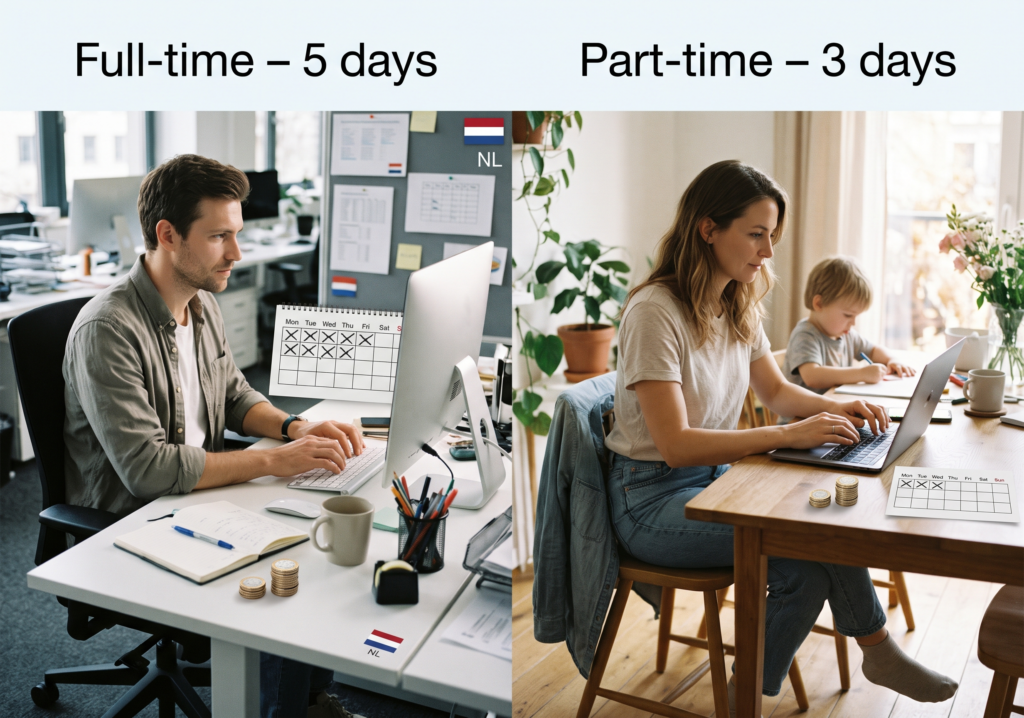
How Does Tax Work When You Work Part-Time?
Dutch tax does not depend on your hours. It depends on your yearly income. When you work fewer hours, you earn less. As a result, more of your income falls into the lowest tax bracket.
These are the 2026 rates for most employees below state pension age. They include national insurance contributions:
- Up to €38,883: about 35.75%
- €38,883 to €78,426: about 37.56%
- Above €78,426: 49.50%
You only pay a higher rate on the part of your income above the limit. Many part-timers stay in the first bracket, which keeps their tax pressure low. For a full overview of all brackets and boxes, read our Dutch Income Tax 2026 Complete Guide.
Tax Credits: The Big Advantage of Part-Time Work
Two tax credits shape your net salary: the general tax credit (algemene heffingskorting) and the labour tax credit (arbeidskorting).
General tax credit. The maximum in 2026 is €3,115. You get this full amount up to an income of €29,736. Above that, the credit shrinks by 6.398% of each extra euro. At €78,426 or more, it is €0.
Labour tax credit. The maximum in 2026 is about €5,700. You reach this top amount at a labour income of about €45,592. After that, the credit slowly decreases.
Your employer applies both credits automatically through the payroll tax credit (loonheffingskorting). You do not need to request anything.
The effect is clear. If you earn less than €29,736, you receive the full general tax credit. A full-timer with a higher salary receives less.
Example: Full-Time vs Three Days a Week
Imagine a full-time salary of €48,000 gross per year, including holiday allowance. Working three days a week means 60% of the hours, so €28,800 gross. This is what it looks like:
| Full-time (5 days) | Part-time (3 days) | |
| Gross yearly income | €48,000 | €28,800 |
| Tax + national insurance (before credits) | about €17,325 | about €10,296 |
| General tax credit | about €1,947 | €3,115 |
| Tax after general tax credit | about €15,378 | about €7,181 |
| Effective tax rate (before labour credit) | about 32% | about 25% |
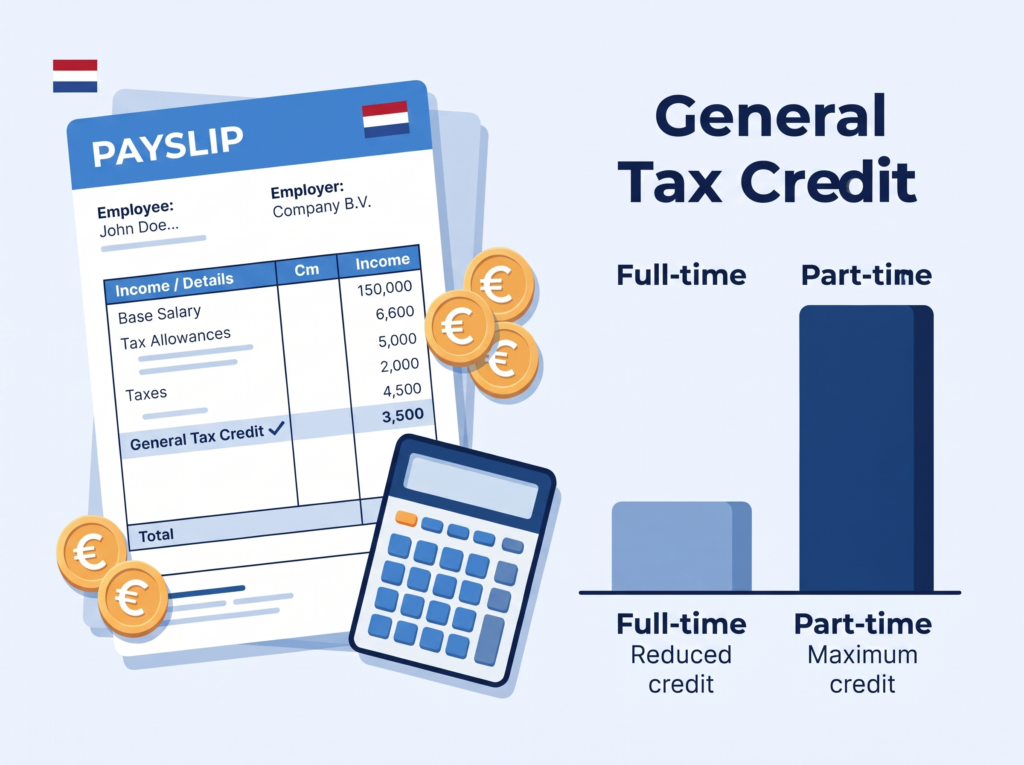
Please note that the labour tax credit is not included here. It lowers the tax in both columns, so your real net pay is higher than these figures show.
The result is interesting. You work 60% of the hours, yet you keep about 66% of the full-timer’s net income before the labour credit. Once the labour credit is included, the share rises to roughly 70%. The higher general tax credit makes the difference.
Want to see your own numbers? Try the Dutch Tax Calculator 2026 and compare different working hours in seconds.
What Happens to Your Holiday Allowance?
Part-timers also receive 8% holiday allowance. It is calculated on your own gross salary, so it is proportional to your hours. If you earn €2,000 gross per month (excluding holiday allowance), you build up €160 per month.
When the allowance is paid out, your payslip may show less than you expected. Withholding on a lump sum can be higher than your final tax. Any difference is settled in your yearly tax return. In the calculator, you can switch “Holiday allowance included” on or off to see both results.
Two Part-Time Jobs? Watch the Payroll Tax Credit
Do you work for two employers? Then one rule matters. You can apply the payroll tax credit at only one employer.
Usually, you choose the higher-paying job. The other employer withholds more tax, which can feel like a lower net salary. The difference is corrected later in your tax return. If you apply the credit at both employers, you may have to pay tax afterwards. The tax authority adds up all your income at the end of the year.
Allowances and Part-Time Work
A lower income can give you the right to allowances, such as the healthcare allowance (zorgtoeslag). Whether you qualify depends on your total income and your situation, for example your partner, your housing and your assets. Always check this on the official website of the Belastingdienst.
How to Use the Calculator Step by Step
- Enter your gross income.
- Choose the period: year, month, week, day or hour.
- Select tax year 2026.
- Fill in your hours per week.
- Tick whether holiday allowance is included.
- Read your net income per year, month and week.
Try different hours to see what an extra working day really earns you. This helps when you talk to your employer about working more or fewer hours.
Frequently Asked Questions
Do I pay less tax if I work part-time?
In total, yes, because your income is lower. The percentage can also be lower, thanks to the full general tax credit.
How many hours is part-time in the Netherlands?
There is no fixed limit. Full-time usually means 36 to 40 hours a week. Anything below that is part-time.
Do part-timers get holiday allowance?
Yes. You receive 8% of your gross salary. The amount is lower because your salary is lower.
Can I use the tax credits at two employers?
No. You can apply the payroll tax credit at only one employer. The difference is settled in your tax return.
Is this calculation exact?
No. These are estimates. Your own situation can differ, for example because of deductions or pension contributions.
Conclusion
Working part-time gives you more free time and often a lower tax rate. You pay tax on a smaller income and receive the full general tax credit. That is why your net pay falls less than your hours. Use the Dutch Tax Calculator 2026 Part time to test your own situation before you make a choice.
In total, yes, because your income is lower. The percentage can also be lower, thanks to the full general tax credit.
There is no fixed limit. Full-time usually means 36 to 40 hours a week. Anything below that is part-time.
Yes. You receive 8% of your gross salary. The amount is lower because your salary is lower.
No. You can apply the payroll tax credit at only one employer. The difference is settled in your tax return.
No. These are estimates. Your own situation can differ, for example because of deductions or pension contributions.

John Keller is the founder of Look Forward Administratie & Advies and a Dutch financial administration and tax advisory specialist. With 25 years of experience helping expats, freelancers, and businesses navigate Dutch payroll, income tax, and the 30% ruling, he combines hands-on advisory experience with a focus on making Dutch tax rules understandable for non-Dutch speakers.