What Is the 30% Ruling in the Netherlands? Complete 2026 Guide
Table Of Content
- What Is the 30% Ruling in the Netherlands? Complete 2026 Guide
- What Is the 30% Ruling and Why Does It Exist?
- How the 30% Ruling Works: Step by Step
- The Tax Saving Mechanism
- The 2026 Salary Cap (Normsalaris)
- Who Qualifies for the 30% Ruling in 2026?
- Condition 1: Employment Relationship with a Dutch Employer
- Condition 2: Minimum Salary Threshold (2026)
- Condition 3: Specific Expertise Scarcity
- Condition 4: Prior Residence Outside the Netherlands (150km Rule)
- Duration of the 30% Ruling in 2026
- Changing Jobs with the Ruling
- What Changed in 2026
- Partial Non-Resident Status Abolished
- ETK Scheme Tightened
- How to Apply for the 30% Ruling
- What Documents Are Required
- Salary Calculation Examples
- Reasons Applications Are Rejected
- Frequently Asked Questions
- Summary: 30% Ruling Netherlands 2026
The 30% ruling (30%-regeling) is the Netherlands’ most significant tax benefit for international employees and one of the most generous expat tax schemes in Europe. In 2026, it allows qualifying foreign employees to receive 30% of their gross salary completely tax-free, dramatically increasing take-home pay.
But the rules have tightened significantly in recent years. The 2026 salary cap, the abolition of partial non-resident status, and a further reduction in the ruling’s duration mean that understanding the current rules, not the older version you may have read about, is essential.
This guide covers everything: eligibility, the 2026 salary thresholds, how the tax saving is calculated, the application process, what changed in 2026, and answers to the questions applicants most commonly get wrong.
What Is the 30% Ruling and Why Does It Exist?
When a Dutch employer recruits a specialist from abroad, that employee incurs costs that local hires do not: relocation expenses, temporary housing, language courses, extra travel to visit family, and a higher cost of living compared to their home country. These are collectively called extraterritorial costs (extraterritoriale kosten).
Rather than requiring employers and employees to track and document every extraterritorial expense, the Dutch government offers a flat-rate facility: if you qualify, 30% of your agreed salary is treated as a tax-free reimbursement for these costs automatically, without needing receipts.
The result: only 70% of your gross salary is subject to income tax. For a high earner, this is a substantial benefit.
How the 30% Ruling Works: Step by Step
The Tax Saving Mechanism
Under the 30% ruling, your employer pays you the same agreed gross salary but 30% of it is reclassified as a tax-free expense reimbursement. You only pay income tax (Box 1) on the remaining 70%.
Example:
| Without ruling | With 30% ruling | |
|---|---|---|
| Agreed gross salary | €90,000 | €90,000 |
| Tax-free portion (30%) | €0 | €27,000 |
| Taxable income (Box 1) | €90,000 | €63,000 |
| Estimated income tax (approx.) | ~€33,000 | ~€19,000 |
| Approximate net salary | ~€57,000 | ~€71,000 |
| Annual tax saving | — | ~€14,000 |
The saving in this example is approximately €14,000 per year just from restructuring the same gross salary. Over a 5-year ruling period, that is €70,000 in additional take-home pay.
The 2026 Salary Cap (Normsalaris)
The maximum salary on which the 30% ruling can be applied is capped at the Balkenende norm, the maximum annual salary of senior public servants. In 2026, this cap is €262,000 gross.
This means: if your salary is €350,000, the ruling applies to the first €262,000. The remaining €88,000 is taxed normally.
For most international hires, this cap is not a limiting factor. It primarily affects senior executives and high-paid specialists in finance and technology.
Who Qualifies for the 30% Ruling in 2026?
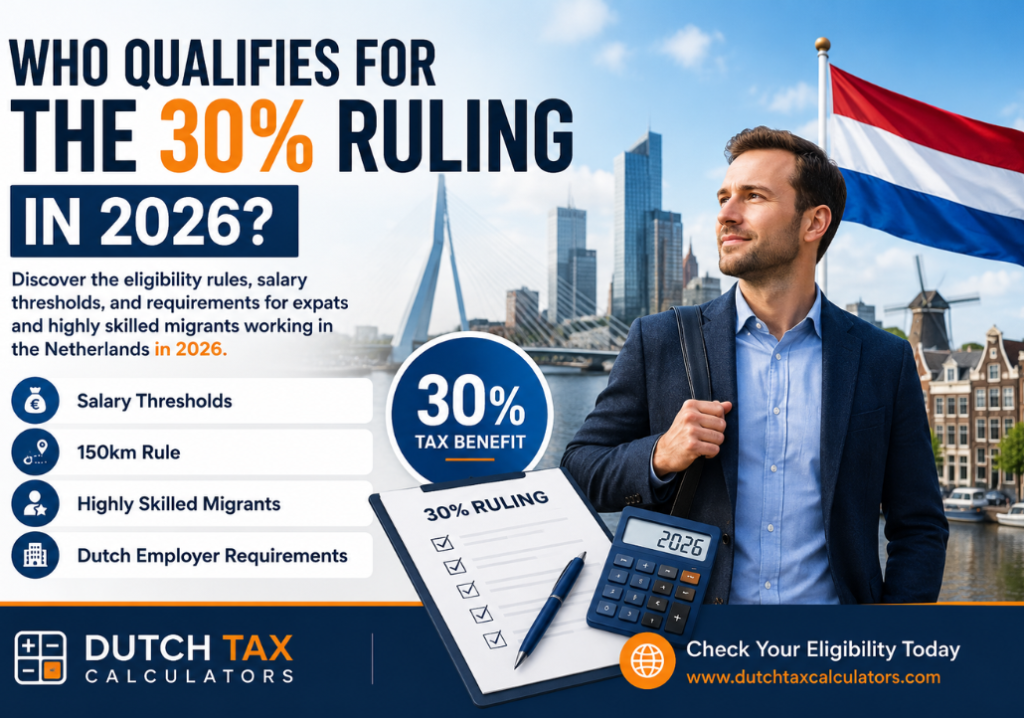
Eligibility depends on four conditions, all of which must be met simultaneously.
Condition 1: Employment Relationship with a Dutch Employer
You must be employed by a Dutch employer (or a foreign employer registered with the Dutch payroll tax system). The ruling applies to employees not to self-employed ZZP’ers or freelancers. If you work through your own BV (private limited company) as a director-major shareholder, you may qualify in your role as an employee of your BV, subject to meeting the salary and expertise requirements.
Condition 2: Minimum Salary Threshold (2026)
After the 30% portion is excluded, your remaining taxable salary must meet a minimum threshold:
| Category | Minimum taxable salary (2026) | Equivalent gross salary |
|---|---|---|
| General rule | €46,107 after ruling | ~€65,867 gross |
| Under 30 with a master’s degree | €35,048 after ruling | ~€50,069 gross |
| Scientific researchers and medical interns | No minimum | Exempt from threshold |
What this means in practice:
- If you earn €70,000 gross, your taxable salary with the ruling is €49,000 above the €46,107 threshold. You qualify.
- If you earn €60,000 gross, your taxable salary with the ruling is €42,000 below the threshold. You do not qualify on salary alone.
- If you are under 30 with a Dutch or internationally recognised master’s degree and earn €52,000 gross, your taxable salary is €36,400 above the reduced €35,048 threshold. You qualify.
The thresholds are updated every January 1 based on wage inflation.
Condition 3: Specific Expertise Scarcity
The employee must possess expertise that is scarce in the Dutch labour market. This is assessed based on:
- Level of education
- Specialisation of knowledge or skills
- Years of relevant professional experience
- Demand in the Dutch labour market
In practice, the scarcity requirement is usually demonstrated by meeting the salary threshold the assumption being that an employer willing to pay above the threshold is doing so because the required expertise is not easily found locally. However, the Belastingdienst may scrutinise applications in sectors where Dutch candidates are readily available.
Condition 4: Prior Residence Outside the Netherlands (150km Rule)
This is the most commonly misunderstood condition and the most frequent reason for rejection.
In the 24 months immediately before starting Dutch employment, the employee must have lived at least 150 kilometres from the Dutch border for a minimum of 16 out of those 24 months.
The 150km distance is measured from the Dutch border not from Amsterdam or any specific city.
Cities/areas that typically fall within 150km and therefore disqualify applicants:
- Brussels, Antwerp, Ghent (Belgium) – within ~50–150km depending on location
- Düsseldorf, Cologne, Dortmund (Germany) – within ~100–150km
- Luxembourg City – approximately 230km (usually qualifies)
- Paris – approximately 450km
- London – approximately 360km across the North Sea
- Zurich – approximately 700km
- New York, Singapore, Dubai – all clearly qualify
Key nuance: The 150km rule looks at where you lived not where you were born or where your employer is based. If you were born in France but lived in Antwerp for the 2 years before starting in Amsterdam, you do not qualify.
Exceptions to the 150km rule:
- PhD researchers being hired directly by Dutch universities
- Some positions at international research institutes
- Returning Dutch nationals who lived abroad long enough
Duration of the 30% Ruling in 2026
The ruling currently lasts for a maximum of 5 years from the start of your Dutch employment. This was reduced from the previous 8-year maximum (for applications before 2019) through a phased reform.
If You Already Have the Ruling
If you received the ruling under previous rules (before 2019), transitional arrangements may have extended your period. The general principle is that the maximum total period is 5 years but transitional rules have varied. If you are uncertain about your end date, check your most recent ruling decision letter (beschikking).
Changing Jobs with the Ruling
If you change employers during your 5-year window, the ruling does not automatically transfer. Your new employer must:
- Apply for the ruling within 3 months of your employment start date with them
- The gap between jobs must be no more than 3 months
If the gap exceeds 3 months, you lose the remaining ruling period entirely and cannot reapply.
The 5-Year Period Is Reduced by Time Previously Spent in the Netherlands
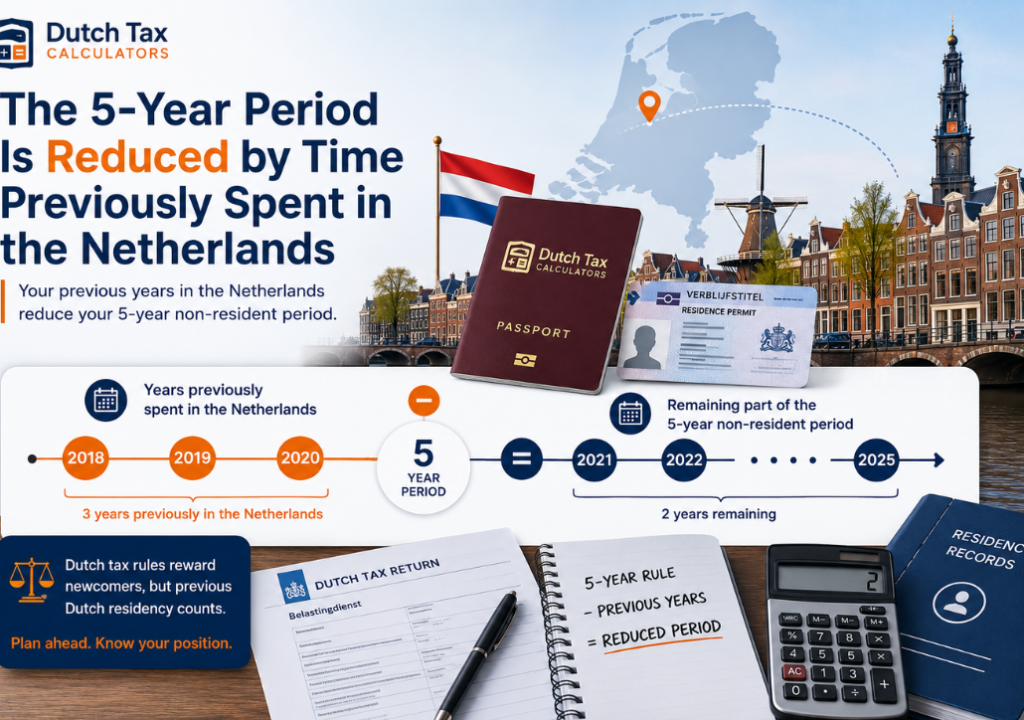
Any period you previously lived or worked in the Netherlands within the 25 years before your current employment reduces your maximum ruling duration. For example:
- If you worked in the Netherlands 5 years ago for 2 years, your current maximum ruling period is 3 years (5 − 2 = 3).
What Changed in 2026
1. Partial Non-Resident Status Abolished
Until 31 December 2025, 30% ruling holders could elect partial non-resident tax status for Box 2 and Box 3. This meant they could be taxed as a non-resident for their foreign savings, investments, and shareholdings effectively excluding overseas assets from Dutch Box 3 wealth tax.
From 1 January 2026, this option no longer exists. All Dutch residents including 30% ruling holders are now full residents for tax purposes and must declare worldwide assets in Box 3. If you held foreign savings, investment accounts, or property exclusively because of this exemption, you should consult a tax advisor urgently.
2. ETK Scheme Tightened
The ETK (Extraterritoriaal Kostenregeling) the alternative to the flat 30% rate where actual extraterritorial costs are reimbursed tax-free has had two categories removed from 2026:
- Additional living costs (gas, water, electricity, and other household utilities)
- Private phone calls to your home country
If your employer uses the ETK method rather than the flat 30% rate, these costs are no longer reimbursable tax-free.
3. Salary Cap Adjusted
The maximum salary cap (Balkenende norm) increased slightly to €262,000 in 2026, adjusted for public sector wage growth.
How to Apply for the 30% Ruling
Who Files the Application
The application is a joint submission by the employer and employee together. The employee cannot apply alone.
Where to Submit
Applications are submitted to: Belastingdienst, Team Buitenland (the international team that handles non-resident and expat matters).
Online submission is available via mijn.belastingdienst.nl with DigiD, or by post using the official aanvraagformulier 30% faciliteit.
Timing and the 4-Month Rule
The application should be submitted within 4 months of the start of employment. If it is submitted within this window and approved, the ruling applies retroactively from day one of employment.
If you apply after the 4-month window, the ruling only takes effect from the first day of the month in which the application was submitted meaning you lose the tax benefit for those early months permanently.
Example:
- Employment start date: 1 March 2026
- Application submitted: 15 June 2026 (within 4 months) → ruling applies from 1 March 2026
- Application submitted: 15 August 2026 (after 4 months) → ruling only applies from 1 August 2026 (5 months of benefit lost)
What Documents Are Required
| Document | Notes |
|---|---|
| Completed application form (jointly signed) | Available at belastingdienst.nl |
| Copy of employment contract | Must show agreed gross salary |
| Proof of prior residence abroad | Utility bills, rental contracts, employer letters showing address outside 150km zone for 16 of last 24 months |
| Proof of qualifications | Degree certificates, translated if necessary |
| Proof of scarcity or salary level | CV, job description, or salary evidence |
| Copy of passport | Identity verification |
The Belastingdienst typically processes applications within 10–13 weeks. Complex cases or missing documents can extend this significantly.
After Approval
You receive a beschikking (official decision letter) stating the ruling has been granted and specifying:
- Start date
- End date (maximum 5 years from employment start)
- The employer who applied
Share this letter with your payroll department immediately. Your employer must apply the 30% exclusion in every payslip from the ruling start date.
Salary Calculation Examples
Example 1 – IT Specialist
- Gross salary: €85,000
- 30% tax-free portion: €25,500
- Taxable Box 1 income: €59,500
- Estimated tax (approx., before credits): ~€18,200
- After general + labour credits: ~€14,000 tax
- Approximate net annual salary: ~€71,000
Without the ruling, the same €85,000 would result in approximately ~€57,000 net the ruling saves approximately €14,000/year.
Example 2 – Young Professional with Master’s Degree (under 30)
- Gross salary: €52,000
- 30% tax-free portion: €15,600
- Taxable income: €36,400 (above the €35,048 reduced threshold)
- Estimated tax (approx.): ~€8,200
- After credits: ~€4,500 tax
- Approximate net salary: ~€47,500
Without the ruling: approximately ~€38,000 net saving approximately €9,500/year.
Example 3 – Senior Finance Professional (above salary cap)
- Gross salary: €300,000
- Ruling applies only up to the €262,000 cap
- Tax-free portion: €262,000 × 30% = €78,600
- Taxable income: €221,400 (€300,000 − €78,600)
- Income above €78,426 taxed at 49.5% → significant but still lower effective rate
- Annual saving vs no ruling: approximately €26,000–€30,000
Reasons Applications Are Rejected
Understanding why applications fail helps you prepare correctly.
| Rejection reason | How to avoid it |
|---|---|
| Salary below the threshold | Ensure gross salary converts to a taxable salary above €46,107 (or €35,048 for young masters) after the 30% exclusion |
| Lived within 150km of Dutch border | Document your actual prior address carefully; borderline cases require strong evidence |
| Application filed more than 4 months after employment start | File immediately on or before the start date if possible |
| Gap between jobs exceeded 3 months | Plan job transitions carefully; try to keep the gap under 3 months |
| Employer cannot demonstrate scarcity | Ensure the job description and your CV clearly show specialised expertise |
| Missing documentation | Use the checklist above and submit a complete application |
| Returning Dutch nationals who did not live abroad long enough | Dutch nationals must demonstrate continuous residence abroad for the 16-of-24-month period |
Frequently Asked Questions
Q1: Does the 30% ruling apply to bonuses and other variable pay?
Yes. The 30% exclusion applies to all agreed compensation including performance bonuses, holiday allowances, and other remuneration provided they are included in the employment contract or salary structure. The employer applies the 30% exclusion before calculating withholding tax on all components.
Q2: I changed employers. Do I need to reapply?
Yes. The ruling does not automatically transfer between employers. Your new employer must submit a fresh application within 3 months of your start date. The total ruling period is still capped at the original 5 years the new application continues the clock, it does not reset it.
Q3: What happens at the end of the 5-year ruling period?
The 30% exclusion stops automatically on the expiry date in your beschikking. Your full gross salary becomes taxable in Box 1 from the following month. You do not receive any notification you must track your own end date. Employers are responsible for removing the exclusion from payroll on time.
Q4: Does the 30% ruling affect my pension build-up?
The 30% ruling may affect the base salary used for pension calculations in your employer’s pension scheme. Some schemes calculate contributions on the full gross salary, others on the taxable portion. Check your pension scheme rules in some cases, employees and employers can choose which base applies.
Q5: What if I become partially self-employed while on the 30% ruling?
The ruling only applies to your employed income. If you take on ZZP assignments alongside your employment, the freelance income is taxed separately in Box 1 as self-employment profit the 30% exclusion does not extend to it.
Q6: Can my spouse or partner also benefit from the 30% ruling?
No. The ruling applies only to the qualifying employee. However, your fiscal partner benefits indirectly a higher household net income, and potentially a more favourable allocation of Box 3 assets and deductions between partners.
Summary: 30% Ruling Netherlands 2026
| Key point | 2026 figure / rule |
|---|---|
| Tax-free portion of salary | 30% |
| Maximum eligible salary (Balkenende norm) | €262,000 |
| Minimum taxable salary (general) | €46,107 |
| Minimum taxable salary (under 30, master’s degree) | €35,048 |
| Maximum duration | 5 years |
| Prior residence requirement | 150km from Dutch border for 16 of 24 months |
| Application deadline (for retroactive benefit) | Within 4 months of employment start |
| Partial non-resident status | Abolished from 1 January 2026 |
| ETK changes | Utilities and home-country calls no longer tax-free |
Use our free Dutch Tax Calculator to estimate your net salary with and without the 30% ruling enter your gross salary and see your take-home pay under both scenarios instantly.
Disclaimer: This guide is for informational purposes only and does not constitute tax advice. The 30% ruling involves individual circumstances that affect eligibility. Always consult a qualified Dutch tax advisor (belastingadviseur) or expat tax specialist before making decisions based on the ruling.

John Keller is the founder of Look Forward Administratie & Advies and a Dutch financial administration and tax advisory specialist. With 25 years of experience helping expats, freelancers, and businesses navigate Dutch payroll, income tax, and the 30% ruling, he combines hands-on advisory experience with a focus on making Dutch tax rules understandable for non-Dutch speakers.