
Dutch Income Tax 2026:The Complete Guide

What Is the Dutch Income Tax System?

Whether you are a salaried employee, a freelancer, an expat, or a business owner living in the Netherlands, understanding Dutch income tax in 2026 is essential to managing your finances and staying compliant with the Belastingdienst (Dutch Tax Authority).

The Netherlands uses a “box” system that divides taxable income into three separate categories. Every resident taxpayer must declare income across whichever boxes apply to their situation  each box has its own rates, rules, and deductions.

BoxWhat it covers2026 rate
Box 1Income from employment, freelance work, pension, and own home35.75% – 49.50%
Box 2Income from a substantial interest (≥5% shareholding in a company)24.50% / 31%
Box 3Wealth from savings, investments, and other assets36% (on deemed return)

Box 1 — Income from Work & Home (2026 Rates)

Box 1 is the most relevant category for the vast majority of people in the Netherlands. Since 2024, the Netherlands uses a three-bracket progressive system that creates a middle tier to differentiate lower and middle incomes while keeping the top rate unchanged at 49.50%.

BracketRateIncome RangeNotes
135.75%Up to €38,883Includes social security (AOW, Anw, Wlz)
237.56%€38,883 – €78,426Pure income tax (no social security)
349.50%Above €78,426Max deduction rate capped at 37.56%

Special rates for AOW pension recipients

If you have reached state pension age (AOW-leeftijd), reduced rates apply in Bracket 1. For those born on or after 1 January 1946, the combined Bracket 1 rate is 17.85%. For those born before 1 January 1946, this lower rate applies to income up to €41,123.

Deduction rate cap for high earners

If your taxable income is €78,426 or above, be aware that personal deductions — including mortgage interest, the entrepreneur allowance, and the SME profit exemption — are capped at 37.56% (the second bracket rate), even though your marginal rate is 49.50%.

Box 2 — Substantial Business Interest

Box 2 applies if you and your fiscal partner together own at least 5% of the shares or voting rights in a company (BV, NV, or cooperative). This mainly affects director-major shareholders (DGAs) and business founders.

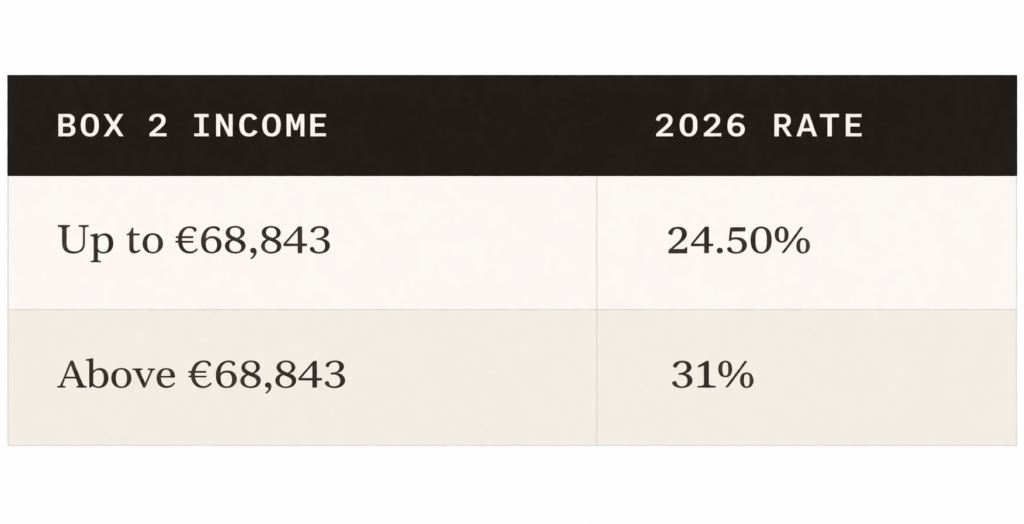
The lower bracket threshold increased by €1,039 from 2025, allowing slightly more income to benefit from the 24.5% rate. For fiscal partners, both can use the first bracket individually  meaning a combined dividend can be more tax-efficient when split between partners.

“Dutch Box 2 income tax rates for 2026 showing 24.50% for income up to €68,843 and 31% for income above €68,843.”

Box 3 — Wealth Tax on Savings & Investments

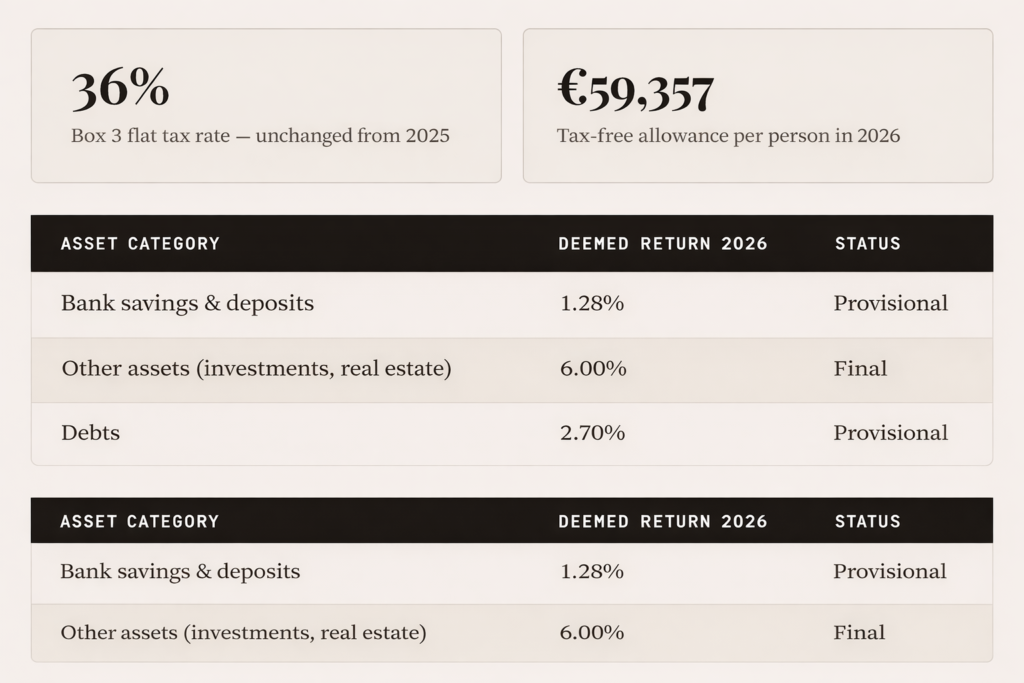
Box 3 is arguably the most debated part of Dutch tax law in recent years. Rather than taxing your actual returns, the Belastingdienst calculates a notional (deemed) return on your net assets above the tax-free threshold, then taxes that figure at a flat rate.

“Netherlands Box 3 tax 2026 showing 36% flat tax rate, €59,357 tax-free allowance, and deemed returns for assets including bank savings (1.28%), other assets (6.00%), and debts (2.70%) with status labels.”

Key Tax Credits for 2026

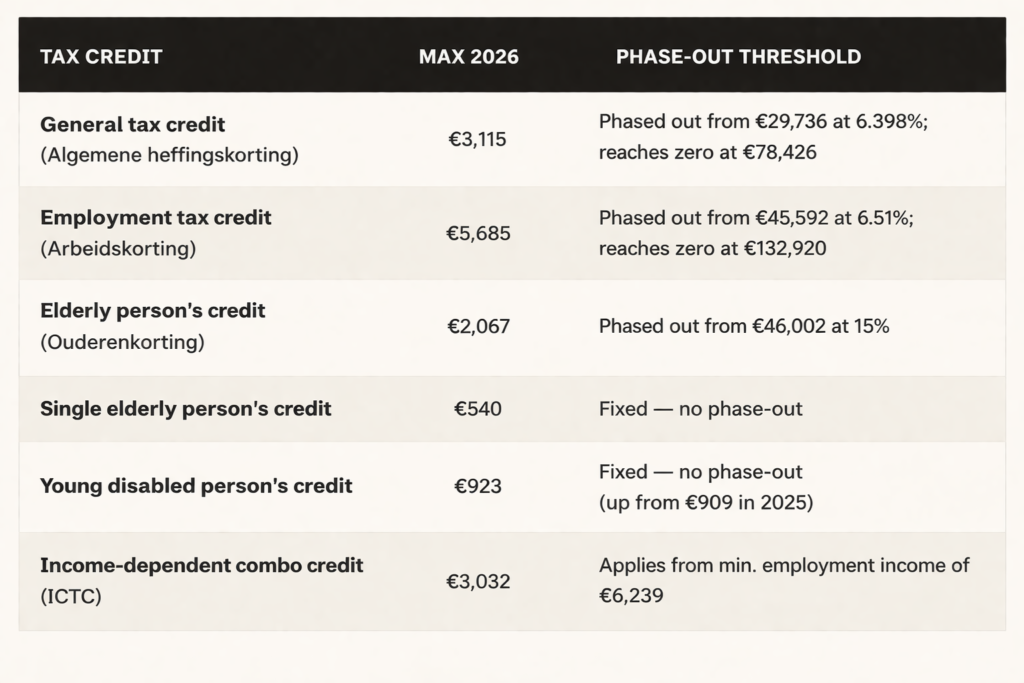
Tax credits (heffingskortingen) directly reduce your tax liability and are more powerful than deductions. The two most impactful credits  the general credit and the employment credit  benefit the vast majority of Dutch taxpayers.

“Netherlands tax credits 2026 with amounts and phase-out thresholds table.”

The general tax credit phases out completely at €78,426 aggregate income, meaning high earners receive no general credit. The employment credit disappears at €132,920 employment income.

Tax Rules for Entrepreneurs & Freelancers in 2026

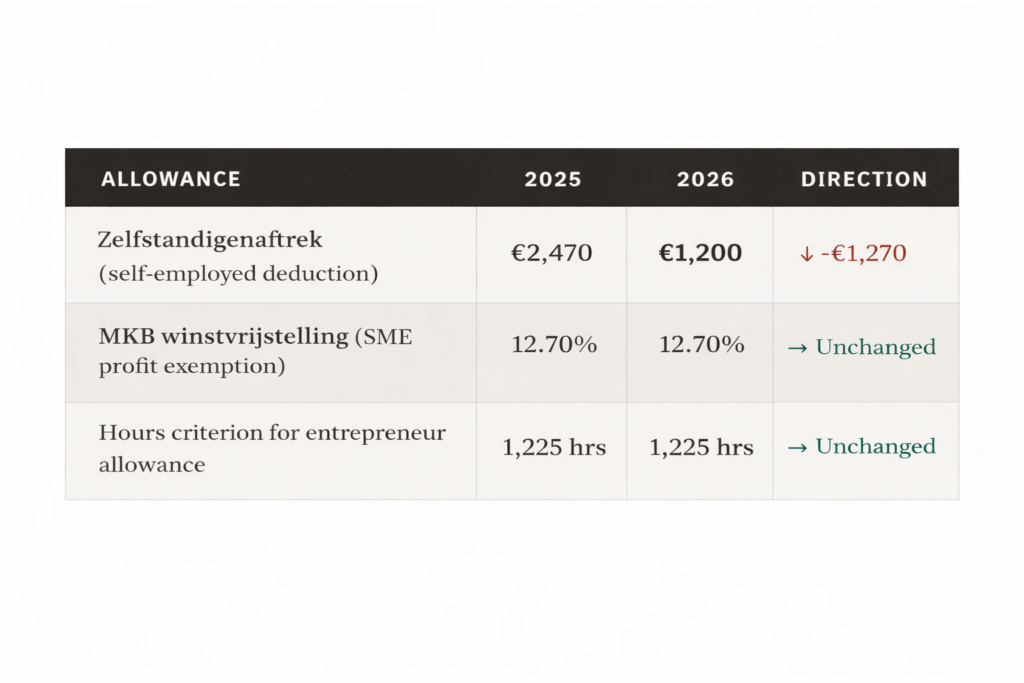
If you work as a ZZP’er (zelfstandige zonder personeel) or run a sole proprietorship (eenmanszaak) in the Netherlands, 2026 brings a significant financial change that raises the effective tax burden for most self-employed workers.

Key freelancer allowances at a glance

“Dutch entrepreneur tax allowances comparison for 2025 and 2026 showing self-employed deduction reduced from €2,470 to €1,200, SME profit exemption unchanged at 12.70%, and entrepreneur hours criterion fixed at 1,225 hours.”

Running a BV? Corporate tax rates 2026

If you operate through a private limited company (BV), corporate income tax (vennootschapsbelasting) rates remain unchanged in 2026. The first bracket rate of 19% applies to taxable profits up to €200,000, and the top rate of 25.8% applies to profits above that.

Expats & the 30% Ruling in 2026

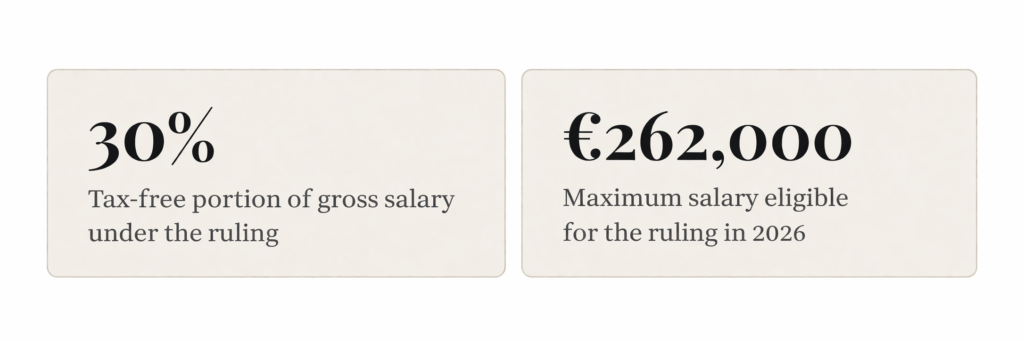
The 30% ruling (30%-regeling) is the Netherlands’ flagship benefit for attracting international talent. It allows qualifying employees to receive 30% of their gross salary as a tax-free expense reimbursement, dramatically reducing effective tax rates for high-earning expats.

“30% ruling Netherlands showing tax-free portion of salary and €262,000 maximum eligible salary for 2026 displayed in two information cards.”

What changed in 2026

The extraterritorial cost reimbursement scheme (ETK regeling) has been tightened. Two previously deductible categories have been abolished from 2026: additional costs of living (gas, water, electricity, and other utilities), and the costs of non-business phone calls to your home country. If you currently rely on these deductions, contact your employer or tax advisor to review your compensation package.

2025 vs 2026 — What Actually Changed?

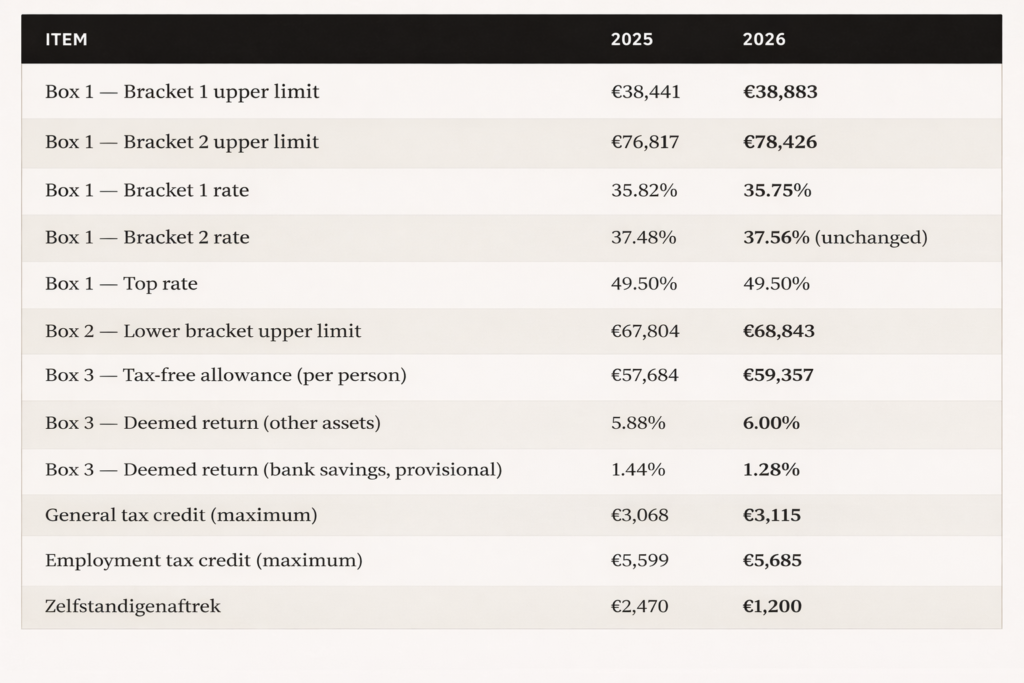
Here is a side-by-side overview of all the key changes between the 2025 and 2026 Dutch tax years, so you can quickly identify what directly affects your situation.

Filing Deadlines & How to File Your Dutch Tax Return

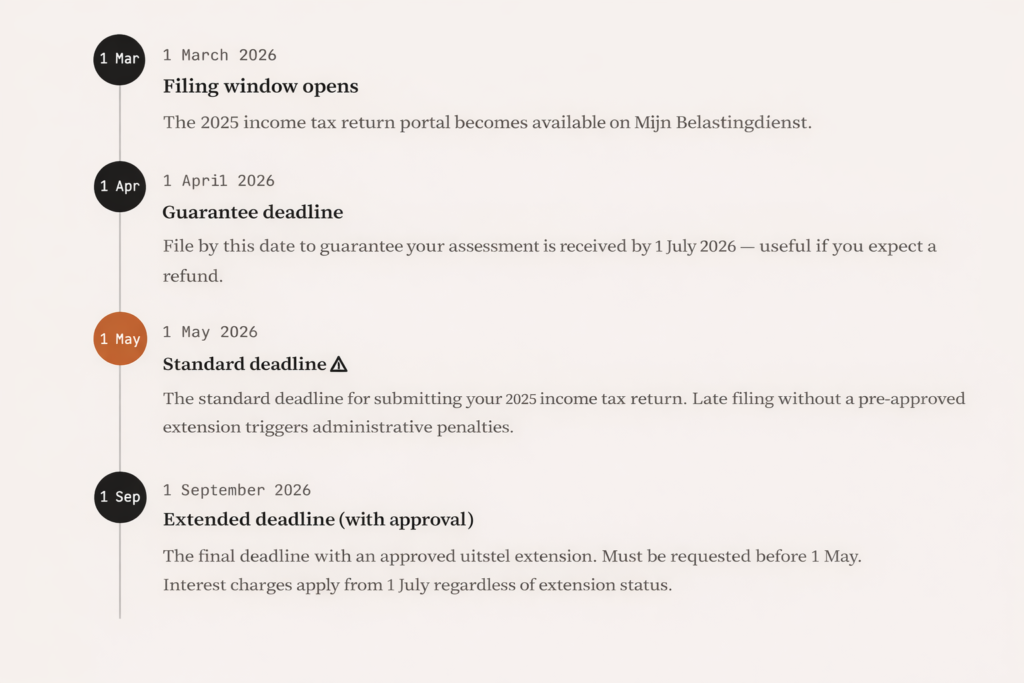
The Dutch tax year follows the calendar year: 1 January to 31 December. Your 2026 income tax return (for the 2025 tax year) must be filed according to the following key dates:

“Netherlands income tax 2026 filing timeline showing key deadlines: March 1 filing opens, April 1 guarantee deadline, May 1 standard deadline, and September 1 extended deadline with approval.”

How to file

Dutch residents file their annual tax return (aangifte inkomstenbelasting) through one of the following: online via Mijn Belastingdienst (Dutch-language portal, requires DigiD), through a registered tax advisor or accountant (belastingadviseur), or using DigiD-compatible tax software. If you arrived in or left the Netherlands during 2025, you typically need to file an M-form (migration year return) rather than the standard return.

Frequently Asked Questions — Dutch Income Tax 2026

The following questions are structured to target Google’s People Also Ask boxes and Featured Snippets for the keyword “Dutch income tax 2026”. Click each question to expand the answer.

What are the Dutch income tax rates for 2026?

In 2026, Dutch income tax (Box 1) uses three brackets: income up to €38,883 is taxed at 35.75%, income between €38,883 and €78,426 is taxed at 37.56%, and income above €78,426 is taxed at the top rate of 49.50%. The Bracket 1 rate includes social security premiums. Brackets 2 and 3 are pure income tax.

What is the tax-free allowance in the Netherlands for 2026?

The Netherlands does not use a single personal tax-free income allowance. Instead, tax credits reduce your bill directly. The maximum general tax credit is €3,115 and the maximum employment tax credit is €5,685 in 2026. For Box 3 wealth, the tax-free exemption is €59,357 per person.

When is the Dutch income tax return deadline in 2026?

The filing window for 2025 income tax returns opens on 1 March 2026. The standard deadline is 1 May 2026. With a pre-approved extension (uitstel), the final deadline is 1 September 2026. Filing late without approval results in administrative penalties, and interest begins accruing from 1 July 2026 regardless.

What is the top income tax rate in the Netherlands in 2026?

The top income tax rate in the Netherlands is 49.50% in 2026, applying to Box 1 income above €78,426. Note that personal deductions — such as mortgage interest and entrepreneur allowances — are capped at the second bracket rate of 37.56% for high earners, not the top rate.

How does the Dutch Box 3 wealth tax work in 2026?

Box 3 taxes a notional (deemed) return on your net assets at a flat rate of 36%. The tax-free allowance is €59,357 per person. The deemed return is 6.0% for investments and other assets, and 1.28% (provisional) for bank savings in 2026. If your actual return was lower, you can dispute the assessment using the OWR form (Opgaaf Werkelijk Rendement).

How is self-employment income taxed in the Netherlands in 2026?

Freelancers and ZZP’ers are taxed under Box 1 at the same progressive rates as employees (35.75%–49.50%). However, the self-employed deduction (zelfstandigenaftrek) has been cut to €1,200 in 2026 — down sharply from €2,470 in 2025 — and will fall to €900 in 2027. You must also meet the 1,225-hour annual work criterion to qualify for entrepreneur allowances.

Does the Netherlands tax foreign income?

The Netherlands has extensive double tax treaties that prevent most foreign income from being taxed twice. However, you are still required to report it correctly. As of 2026, most expats are treated as full residents and must declare worldwide wealth in Box 2 and Box 3 — regardless of their 30% ruling status. The M-form applies in migration years.

What is the 30% ruling and has it changed in 2026?

The 30% ruling allows qualifying international employees to receive 30% of their gross salary tax-free to cover extraterritorial costs. In 2026, the maximum eligible salary cap is €262,000. The scheme has been tightened — utilities (gas, water, electricity) and private phone calls to your home country can no longer be reimbursed tax-free under the ETK scheme from 1 January 2026.

Leave a Comment

Your email address will not be published. Required fields are marked *

Scroll to Top