Dutch Tax Calculator: First Year Take Home Pay
A Dutch tax calculator estimates how much money lands in your bank account after income tax and social contributions in the Netherlands. If you earn €50,000 gross in 2026, you can expect roughly €3,250 net per month before holiday allowance. The exact figure depends on tax credits, your start date, and whether you qualify for the 30% ruling.
This guide explains how to estimate your first year take home pay, what changes in your first year, and which mistakes to avoid.
Why Your First Year in the Netherlands Is Different
Most Dutch tax guides assume you worked here for a full year. Newcomers rarely do. Your first year often includes a partial year of residence, a relocation, and sometimes a different tax status than later years.
Three things make year one unique:
You may be a partial year resident. If you arrive in June, you only owe Dutch tax on income earned from your start date, and tax credits are usually calculated per month of residence.
You may qualify for the 30% ruling. This expat scheme lets your employer pay up to 30% of your salary tax free if you were recruited from abroad and meet the salary requirement.
Your payslip may differ from your final tax bill. Your employer withholds payroll tax each month, but your final bill is settled in your annual tax return.

How Dutch Income Tax Works in 2026
Your salary is taxed in Box 1. For 2026, the main rates for people below state pension age are:
- 35.75% on income up to about €38,883
- 37.56% on income between about €38,883 and €78,426
- 49.50% on income above about €78,426
These rates include social security premiums. The system then reduces your bill with two main tax credits: the general tax credit (algemene heffingskorting) and the labour tax credit (arbeidskorting). Both shrink as income rises, which is why a good calculator matters.
Example: €50,000 Gross Salary
Here is a simplified estimate for a full year resident earning €50,000 gross:
| Item | Approximate amount |
| Tax before credits | €18,100 |
| General and labour tax credits | €7,200 |
| Tax after credits | €10,900 |
| Net annual income | €39,100 |
| Net monthly income | €3,250 |
This is an illustration, not a payslip. Holiday allowance, pension contributions and your exact start date will change the result.
Step by Step: Estimating Your First Year Take Home Pay
Step 1: Enter your gross annual salary. Use the figure in your contract. Check whether it includes the 8% holiday allowance, since many Dutch contracts quote salary without it.
Step 2: Select your start month. Your first year is shorter than twelve months, so your annual income and credits shrink accordingly.
Step 3: Choose your tax status. Indicate whether you are a resident, and whether the 30% ruling applies to you.
Step 4: Add pension and other deductions. Employee pension contributions reduce taxable pay, so your net salary drops by less than the contribution itself.
Step 5: Compare monthly and annual results. Look at both. Monthly net pay helps with budgeting, while the annual figure shows what you keep after the full year.
How the 30% Ruling Changes Your Take Home Pay
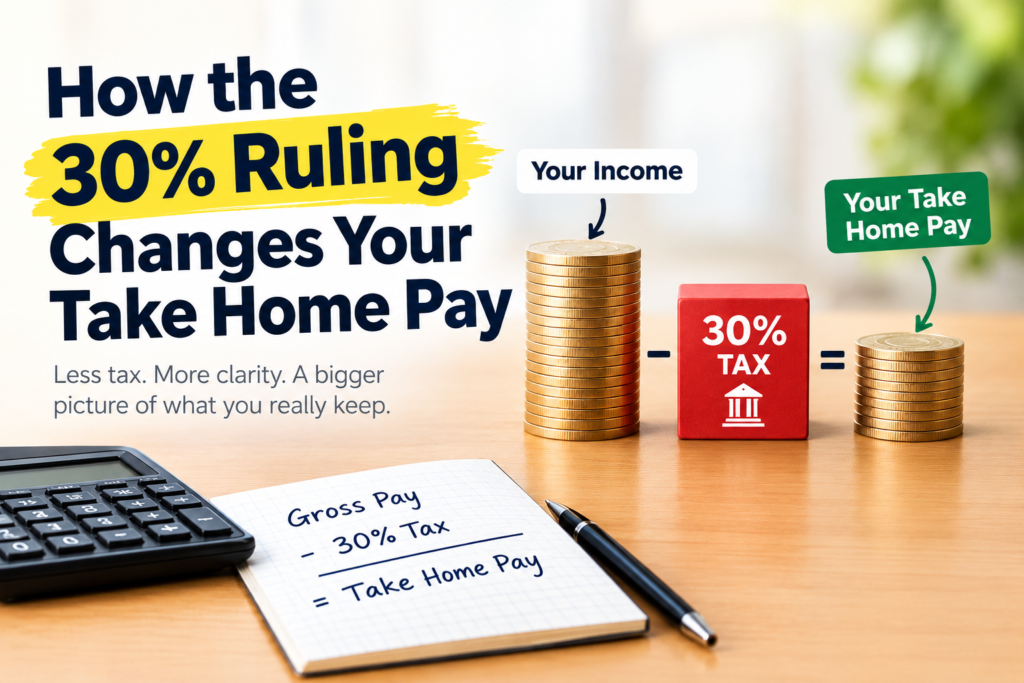
If you qualify, 30% of your salary is paid tax free, which can raise your net income noticeably. For a €60,000 salary, about €18,000 becomes tax free and you are taxed on the remaining €42,000. Eligibility depends on being recruited from abroad, having specific expertise, and meeting the minimum salary threshold. The rules and the percentage are scheduled to change from 2027, so confirm the current conditions with the Dutch Tax Administration or a tax advisor before relying on this benefit in your budget.
Common Mistakes When Using a Dutch Tax Calculator
- Ignoring holiday allowance. It is usually paid once a year, typically in May or June, so it will not appear in every monthly payslip.
- Assuming a full year of credits. Partial year residents may receive reduced credits.
- Forgetting the 30% ruling. Applying it wrongly, or skipping it when eligible, can distort your estimate by thousands of euros.
- Mixing gross and net figures. Always confirm which one your offer letter states.
- Treating the result as a guarantee. A calculator provides an estimate, and your final figure is confirmed through your tax return.
Frequently Asked Questions
How accurate is a Dutch tax calculator?
A good calculator is accurate within a small margin for standard employment situations. Complex cases, such as multiple incomes or foreign assets, may need professional advice.
Do I pay Dutch tax in my first year if I arrive mid year?
Yes. You pay tax on income earned as a resident from your arrival date, and you may also owe tax on certain Dutch sourced income earned earlier.
Is holiday allowance included in my net salary?
Not automatically. It is usually 8% of gross salary, paid separately and taxed at a special rate.
Do I need to file a tax return in my first year?
Often yes, especially if you moved during the year or have income outside your regular payroll. Check your situation with the Dutch Tax Administration.
Final Thoughts
Estimating your first year take home pay helps you negotiate offers, plan rent, and avoid surprises. Start with your gross salary, factor in your start date, apply the 30% ruling if you qualify, and remember that the result is an estimate. Run several scenarios, since small changes in start date or pension choices can shift your net pay.
Disclaimer: This article is for general information and does not replace personal tax advice. Rates and rules change, so verify current figures with the Dutch Tax Administrationor a qualified advisor.

John Keller is the founder of Look Forward Administratie & Advies and a Dutch financial administration and tax advisory specialist. With 25 years of experience helping expats, freelancers, and businesses navigate Dutch payroll, income tax, and the 30% ruling, he combines hands-on advisory experience with a focus on making Dutch tax rules understandable for non-Dutch speakers.