A Dutch tax calculator 2026 bonus check can save you from an ugly surprise. Imagine your employer promises a €5,000 bonus, yet your payslip shows much less. That does not mean someone made a mistake. The Netherlands simply taxes bonuses with a special table. In this guide, you will learn how that table works, how much you keep, and how to check your own number in a few minutes.
Quick Answer: How Is a Bonus Taxed in the Netherlands in 2026?
Your employer withholds tax on a bonus using the bijzonder tarief (special rate). The main percentages in the table follow the three Box 1 bands for 2026:
- 35.75% when your yearly wage is up to €38,883
- 37.56% when your yearly wage is between €38,884 and €78,426
- 49.50% when your yearly wage is €78,427 or more
Keep one point in mind: this is withholding, not your final tax bill. The Belastingdienst settles the final amount after you file your annual tax return.
Why Does a Bonus Look So Heavily Taxed?
There is no extra “bonus tax” in the Netherlands. A bonus counts as normal Box 1 income, just like your salary. The difference lies in how your employer withholds the tax. Your normal salary comes with tax credits (loon he ffings korting) that your employer applies month by month. A one-off payment uses its own table instead. As a result, the amount withheld often looks high, especially for higher earners.
For a deeper look at how Box 1 works, read our Box 1 , Box 2 and Box 3 guide
How Your Employer Picks Your Bonus Rate
Look at your payslip for a line called Jaarloon BT. Your employer uses this yearly wage to find your row in the special table. In most cases, it equals your taxable wage from the previous calendar year. If you worked only part of last year, the employer scales it up to a full year. If you started this year, the employer uses an expected yearly wage.
Be aware that the official table also contains a small adjustment for tax credits at some income levels. For that reason, the exact percentage on your payslip can differ slightly from the three main rates above. Check the Jaarloon BT line before payday, particularly after a big raise. Last year’s wage may then be lower than your real one.
Bonus Examples: From Gross to Net in 2026
This Dutch tax calculator 2026 bonus table shows simple estimates based on the main percentages.
| Yearly wage | Gross bonus | Main rate | Tax withheld | Net bonus |
|---|---|---|---|---|
| €30,000 | €1,000 | 35.75% | €358 | €642 |
| €55,000 | €3,000 | 37.56% | €1,127 | €1,873 |
| €85,000 | €5,000 | 49.50% | €2,475 | €2,525 |
Real payslips may differ by a few euros because of the credit adjustment. Even so, the pattern is clear. The higher your yearly wage, the bigger the slice the tax office takes from the bonus.
Can You Get Some of the Tax Back?
Sometimes, yes. Withholding works as an advance payment. After the year ends, the Bela sting dienst calculates your real tax on all your income. If your employer withheld too much, you receive the difference after you file your return. Our Dutch tax return 2026 guide walks you through each step.
However, a bonus can also push you into a higher band. If your total yearly income goes above €78,426, the part above that line is taxed at 49.50% in any case.
Holiday Allowance and 13th Month: Same Rules Apply
Holiday allowance (vakantiegeld) is usually 8% of your yearly gross wage, and many employers pay it in May or June. The tax office treats it like a bonus. A 13th month works the same way.
Here is a quick example. With a gross salary of €3,500 per month, your holiday allowance is €3,500 × 12 × 8% = €3,360. At a 37.56% rate, about €1,262 is withheld. That leaves roughly €2,098 net.
There is one exception. If your employer pays the holiday allowance in small amounts every month, it falls under the normal monthly tax table. In that case, the special rate does not apply.
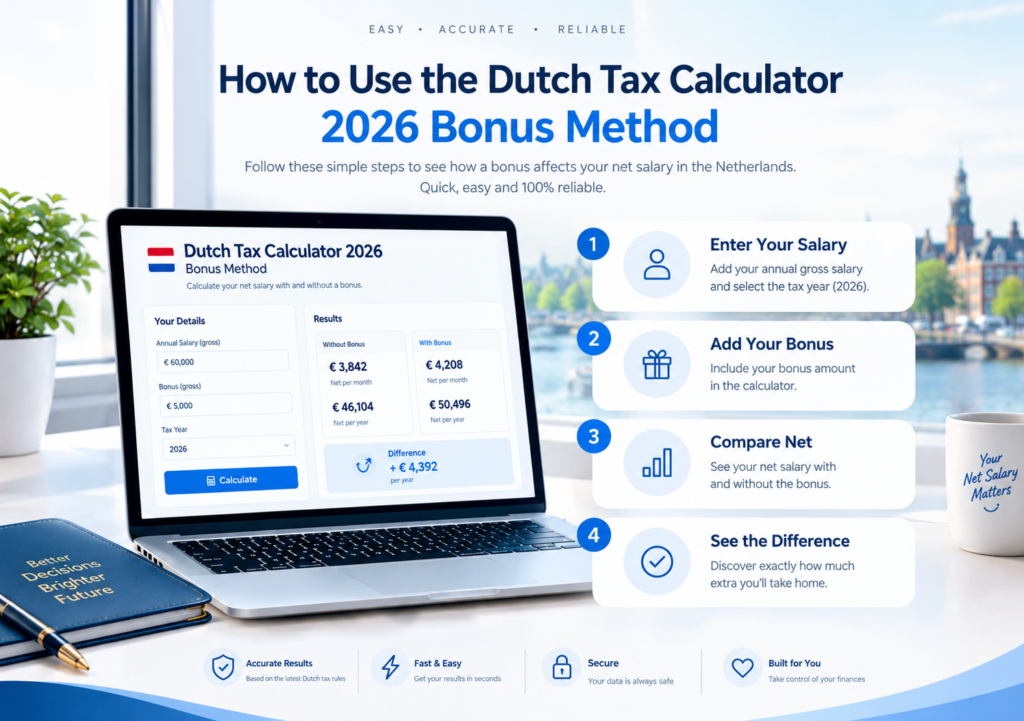
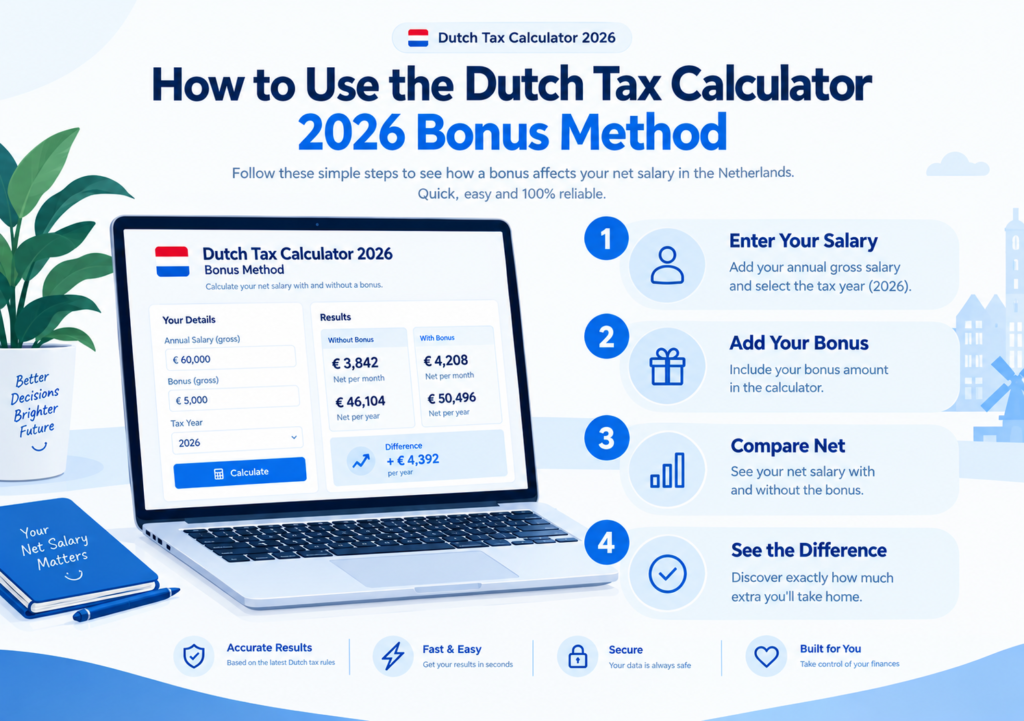
How to Use the Dutch Tax Calculator 2026 Bonus Method
Our Dutch tax calculator has no separate bonus box. Nevertheless, a simple trick gives you the real number:
- Enter your yearly gross salary, choose Year and tax year 2026, and note your net yearly income.
- Add your bonus to the gross amount and calculate again.
- Subtract the first net result from the second one.
- The difference is your net bonus after tax.
Use the holiday allowance option to match your contract. This method shows the effect over the whole year, so it is closer to what you keep after your tax return than the pay slip figure. For more detail on how we calculate, see our methodology page.
Smart Ways to Protect Your Bonus
- Check your payslip. Look at Jaarloon BT before the bonus arrives.
- Ask HR the right questions. Find out whether the bonus is gross or net, and when it is paid.
- Plan with the yearly result. The payslip shows an advance, not your final tax.
- File your return on time. The usual deadline is 1 May.
- Use the 30% ruling? Ask your employer. Check how a bonus is treated in your ruling. Our 30% ruling guide explains the basics.
Frequently Asked Questions
Is a bonus taxed higher than salary in the Netherlands? The withholding often looks higher, but there is no extra bonus tax. A bonus is Box 1 income, and the final tax follows from your annual return.
What percentage is taken from a bonus in 2026? The main percentages are 35.75%, 37.56% and 49.50%, depending on your Jaarloon BT. A small credit adjustment can change the exact figure.
Can I get bonus tax back? Yes. If too much was withheld, you receive the difference after you file your annual tax return.
Is holiday allowance taxed like a bonus? Yes, when it is paid as one lump sum. Monthly payments fall under the normal monthly table.
Final Thoughts
A bonus feels great until you see the net amount. Still, the system is logical: the Netherlands withholds tax in advance and settles the final bill later. Before you spend your bonus, run your numbers with a Dutch tax calculator 2026 bonus check on our free calculator. For a wider view of payslip deductions, read our payroll tax guide.
Disclaimer: This article is for information only and is not tax advice. Rates come from the Belastingdienst 2026 tables and may change. For personal advice, speak to a qualified tax adviser. Official source.

John Keller is the founder of Look Forward Administratie & Advies and a Dutch financial administration and tax advisory specialist. With 25 years of experience helping expats, freelancers, and businesses navigate Dutch payroll, income tax, and the 30% ruling, he combines hands-on advisory experience with a focus on making Dutch tax rules understandable for non-Dutch speakers.