
Tax Calculator 2026: Calculate Your Dutch Tax and Net Salary
Calculating your salary after tax in the Netherlands can be confusing, especially when you have to consider income tax, national insurance contributions, tax credits, holiday allowance, and other factors. A tax calculator makes this process much easier by giving you an estimate of how much money you may actually take home.
If you want a quick estimate based on your income, you can use the Dutch Tax Calculator to calculate your estimated net salary and understand your tax position.
What Is a Tax Calculator?
A tax calculator is an online tool that estimates the amount of tax you may pay based on your income and personal circumstances. Instead of manually working through different tax brackets and credits, you enter your income and relevant details, and the calculator provides an estimated result.
For people working or living in the Netherlands, a Dutch tax calculator can be particularly useful because the Dutch tax system uses progressive rates. This means different portions of your income can be taxed at different rates rather than applying one percentage to your entire salary.
A good calculator can help you estimate your gross income, taxable income, total income tax, tax credits, and net income.
How Does the Dutch Tax Calculator Work?
The Dutch tax system divides income into different categories known as Box 1, Box 2, and Box 3. For most employees, Box 1 is the most relevant because it covers employment income and certain income related to home ownership.
For 2026, Box 1 income for people below state pension age is subject to progressive rates. The first bracket applies up to €38,883, the next bracket runs from €38,883 to €78,426, and income above €78,426 is subject to the highest rate of approximately 49.50%.
Importantly, reaching a higher tax bracket does not mean your entire salary is suddenly taxed at the highest rate. Only the portion of income falling within that bracket is taxed at the corresponding rate.
This is one reason a tax calculator can be useful: it performs these calculations automatically and presents the result in a simpler format.
What Does a Tax Calculator Include?
A useful Netherlands tax calculator can consider several components that influence your final take-home pay.

Gross income: This is your salary before taxes and other deductions.
Payroll tax: Known as loonheffing, this generally includes income tax and national insurance contributions withheld from employment income.
General tax credit: The algemene heffingskorting can reduce your final tax liability, although the amount depends on income.
Labour tax credit: The arbeidskorting is another important credit for people receiving employment or qualifying earned income.
Net income: This is the amount remaining after applicable taxes and credits and represents your estimated take-home pay.
Why Use a Tax Calculator Before Accepting a Job?
A job offer may look attractive when you only consider the gross salary. However, your actual monthly income can be significantly different after taxes and other deductions.
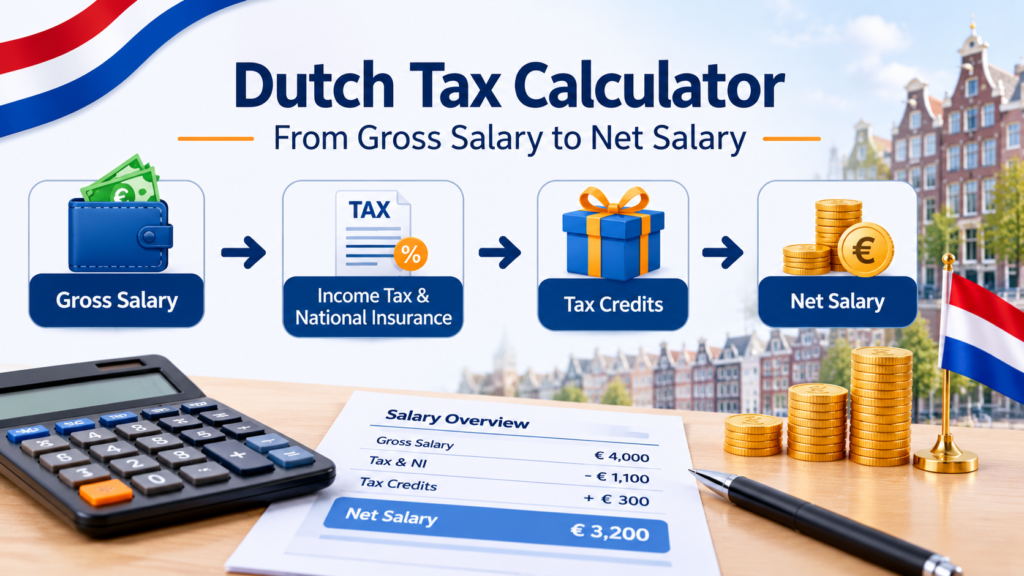
For example, someone comparing two employment offers can use a salary tax calculator to estimate the monthly and yearly net income from each offer. This gives a more realistic basis for comparing salaries.
The calculator can also be useful when negotiating compensation. Instead of asking only, “What is the gross salary?”, you can understand how a salary increase could affect your estimated take-home pay.
This is especially helpful for employees relocating to the Netherlands, expats comparing international job offers, and professionals changing employers.
Tax Calculator for Expats in the Netherlands
Expats may have additional considerations when estimating their Dutch net salary. One important example is the 30% ruling, a tax benefit that may be available to eligible employees who meet the applicable requirements.
Because the 30% ruling can affect taxable income and take-home pay, expats should consider whether they qualify when using a Netherlands tax calculator. The calculator can help illustrate the potential difference between standard taxation and a calculation that includes the ruling.
For a deeper explanation of Dutch income taxation, the Dutch Income Tax 2026 Guide can help you understand how the main calculations work.
What Information Do You Need?
Using a tax calculator is generally straightforward. Depending on the calculator, you may need to enter information such as:
- Gross annual or monthly income
- Pay period
- Tax year
- Working hours
- Holiday allowance
- Age or AOW status
- 30% ruling eligibility
After entering the relevant information, the calculator can provide estimates for annual, monthly, weekly, daily, and hourly net income.
Is a Tax Calculator Accurate?
A tax calculator can provide a useful estimate, but it should not be considered a substitute for personalized tax advice. Your actual tax position may depend on deductions, allowances, employment circumstances, benefits, assets, and changes in Dutch tax regulations.
The best approach is to use a calculator for planning and estimation, then consult the Dutch tax authority or a qualified tax professional when you need advice about your specific situation.
Frequently Asked Questions
What is the purpose of a tax calculator?
A tax calculator estimates how much tax you may pay and how much income you may keep after taxes and applicable credits.
Can I use a tax calculator for my Dutch salary?
Yes. A Dutch tax calculator can help employees estimate their net salary from their gross income.
Does a higher tax bracket tax my entire salary?
No. Under the progressive system, different portions of income are taxed at different rates.
Can expats use a Dutch tax calculator?
Yes. Expats can use a calculator to estimate their Dutch tax and take-home salary, including scenarios involving the 30% ruling when applicable.
Final Thoughts
A tax calculator is a simple way to understand how much of your Dutch salary you may actually keep. Instead of focusing only on gross income, you can estimate taxes, tax credits, and net salary in one place.
Whether you are an employee, expat, freelancer, job seeker, or someone comparing employment offers, calculating your estimated take-home pay can make financial planning easier. For 2026, understanding progressive tax brackets and available tax credits is particularly important when estimating your real income.

John Keller is the founder of Look Forward Administratie & Advies and a Dutch financial administration and tax advisory specialist. With 25 years of experience helping expats, freelancers, and businesses navigate Dutch payroll, income tax, and the 30% ruling, he combines hands-on advisory experience with a focus on making Dutch tax rules understandable for non-Dutch speakers.