
The Dutch tax calculator 2026 shows your real take-home pay after tax in the Netherlands. A €50,000 salary owes roughly €18,000 in Box 1 income tax before credits, which then reduce the bill. Use it to see your net salary before you sign a contract or file a return. You saw a salary offer of €60,000 in the Netherlands, and now you wonder what actually reaches your bank account. The honest answer is that it is clearly less than the headline number, but more than the bracket rates alone suggest. A Dutch tax calculator shows your real take home pay by applying tax brackets, tax credits and special rules in one step. This guide explains what happens between your gross salary and your net pay.
Quick Answer
In the Netherlands, your take home pay is your gross salary minus income tax, plus your tax credits, minus any pension contribution. For 2026, Box 1 rates are 35.75% up to €38,883, 37.56% up to €78,426 and 49.50% above that. For most employees, the average tax rate before credits lands between 35% and 40%, and credits then bring the final bill down.
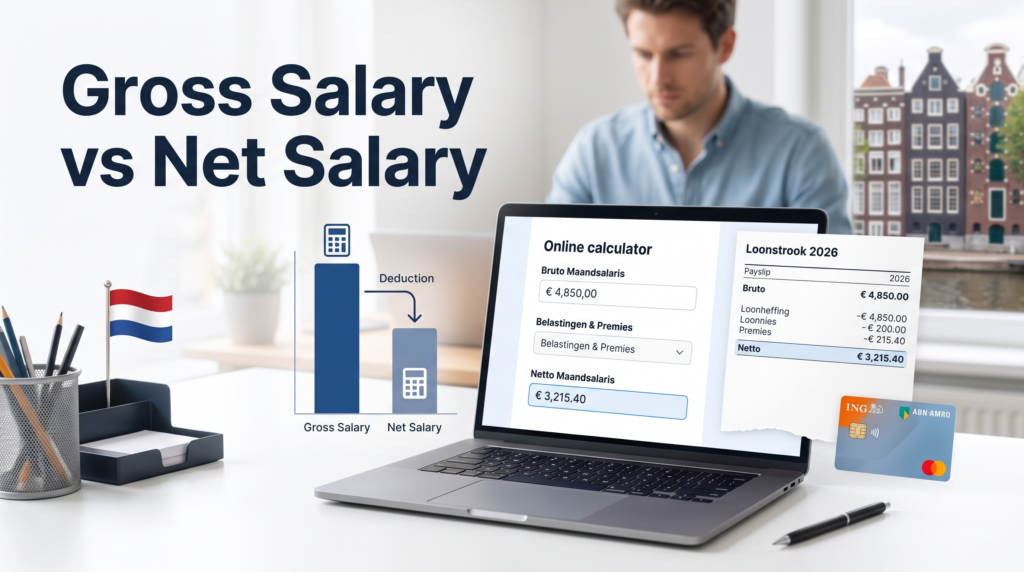
Gross Salary vs Net Salary
Gross salary is the amount in your contract. Net salary is the amount you receive after payroll tax. Your employer withholds this tax each month through a system called loonheffing and pays it to the Belastingdienst, the Dutch Tax Administration. Many people are surprised because Dutch job offers are often written as gross yearly amounts, while rent and bills are paid from the net monthly amount.
What Is Taken From Your Gross Salary?
Several items shape your final take home pay:
- Income tax and national insurance: these are combined inside the Box 1 rates for people below state pension age.
- Tax credits: the general tax credit (algemene heffingskorting) and the labour tax credit (arbeidskorting) reduce your tax bill.
- Pension contribution: many employers deduct a share for a workplace pension, which lowers your net pay but builds long term savings.
- Other deductions: items such as a lease car contribution can also appear on your payslip.
Health insurance is not taken from your payslip. You pay that premium separately each month, so include it in your budget.
Tax Before Credits at Three Salary Levels
This table shows tax before credits using the 2026 brackets. It is a simple estimate, so your real bill will be lower once credits apply.
| Gross yearly salary | Tax before credits | Average rate before credits |
| €40,000 | About €14,320 | About 35.8% |
| €60,000 | About €21,832 | About 36.4% |
| €80,000 | About €29,532 | About 36.9% |
Source: calculated from Belastingdienst 2026 Box 1 rates.
Notice that the average rate rises slowly. Even at €80,000, you do not pay 49.50% on everything. The top rate only touches income above €78,426.
How to Estimate Your Monthly Take Home Pay
Follow these steps with any calculator:
- Enter your gross yearly salary.
- Select the tax year 2026.
- Choose whether you want holiday allowance included.
- Switch on the 30% ruling only if your employer has confirmed it.
- Read the monthly net amount, then subtract your health insurance premium.
This gives a realistic picture of the money you can spend each month.

How Holiday Allowance Changes Your Net Pay
Most Dutch employees receive holiday allowance, called vakantiegeld, which is usually 8% of gross salary. It is often paid once a year, commonly in May or June. It is taxed like normal income, so the amount you receive is lower than the headline figure. Check whether your offer includes it or adds it on top, because this changes your yearly gross by a large amount.
How the 30% Ruling Raises Take Home Pay
The 30% ruling allows an employer to pay up to 30% of gross salary tax free to qualifying expats recruited from abroad. Because less of your salary is taxed, your net pay increases noticeably. Eligibility depends on factors such as salary level and recruitment from abroad, so check current rules with the Belastingdienst before you rely on it in a job negotiation.
Common Mistakes When Using a Tax Calculator
- Entering monthly net pay instead of gross yearly salary.
- Forgetting that holiday allowance may or may not be included.
- Using last year’s rates for a 2026 estimate.
- Ignoring pension contributions that reduce net pay.
- Treating the result as final instead of as an estimate.
Frequently Asked Questions
How much of my salary do I keep in the Netherlands?
It depends on your income, your tax credits and your pension contribution. Enter your gross salary into a calculator to see the exact share you keep.
Is Dutch net pay calculated monthly or yearly?
Tax is withheld monthly, but the system is built on yearly income, so a calculator converts the yearly result into a monthly figure.
Does a higher salary always mean much more take home pay?
Not always. Higher slices of income are taxed at higher rates, and credits shrink as income rises.
Can I trust an online calculator?
It is a reliable estimate using official rates. Only your official assessment from the Belastingdienst is final.
Final Thoughts
Your Dutch take home pay depends on brackets, credits, pension and special rules like the 30% ruling. A calculator turns these moving parts into one clear number. Use it to compare job offers and plan your monthly budget, then confirm major decisions with a qualified Dutch tax advisor.

John Keller is the founder of Look Forward Administratie & Advies and a Dutch financial administration and tax advisory specialist. With 25 years of experience helping expats, freelancers, and businesses navigate Dutch payroll, income tax, and the 30% ruling, he combines hands-on advisory experience with a focus on making Dutch tax rules understandable for non-Dutch speakers.